
Del City Address History by Era
A Del City address can leave traces in several record systems, but each one answers a narrower question. The Oklahoma County Assessor supplies a current account and legal-description lead. The Oklahoma County Clerk records the land instruments that anchor the ownership trail. Metro and Oklahoma Historical Society collections can place a printed name at an address in a particular year. Newspapers, plats, and probate material fill gaps between those points. None should be read as proof of a current household.
| Record source | Era available | Access route | Address evidence |
|---|---|---|---|
| Assessor and County Clerk land records | Current accounts; online land-index start year not published | County portals, Clerk office, official copies | Parcel, legal description, grantor, grantee, and recorded instrument |
| Metro city directories | 1902 onward for metropolitan directories | Metro Special Collections and Research, selected databases | Dated printed address and street-index entry; exact Del City run requires confirmation |
| OHS probate and marriage indexes | 1890-1928 probate; 1889-1951 marriage | OHS Research Center and indexes | Estate or family-name bridge for an earlier county connection |
| Gateway Del City News | Title dates 1953-1980; digitized issues currently 1957-1960 | Gateway, then OHS or library holdings for gaps | Address wording, notices, sales, and local context |
| OHS plat-map index | Del City entries; date varies by plat | Research Center index and copy route | Addition, subdivision, land description, and alternate search terms |
For a recent Del City transfer, start with the assessor account and the latest recorded instrument. For an earlier household question, choose a directory or newspaper year first, then tie its street wording back to the parcel. The record route is deliberately layered: an old printed address is a lead, and the deed or plat supplies the geographic check.
Del City Previous Residents and Deed Chains
The strongest ownership sequence starts with the Oklahoma County Assessor public search. Use the physical address with its directional prefix and block number. If that fails, try the owner in last-name-first form, a wildcard, the subdivision and lot, map number, deed book and page, or the account number. The assessor describes its legal description as a locator, not the final authority. Match it to the recorded instrument before connecting it to an older Del City name.
Next, use the Oklahoma County Clerk public-access route to locate the current owner's purchase instrument. The Clerk is the Registrar of Deeds at 320 Robert S. Kerr Avenue, Room 203, Oklahoma City, and directs users to inspect official records in person when the online index or image is incomplete. The index can lag recording and some sensitive document types are unavailable online. Record the instrument number, recording date, parties, type, book or page, and legal description before requesting or inspecting the image.
- Locate the Del City parcel in the Assessor search and save the account, addition, lot, block, and legal description.
- Find the latest purchase instrument in the County Clerk index using the owner's name and the legal description.
- Read the seller as the grantor, then search that person as a grantee to find the earlier acquisition.
- Repeat the comparison backward, checking each legal description against the parcel and any related plat.
- When the online result is missing or unclear, ask the Clerk about an in-office inspection or an official copy rather than filling the gap with an assumption.
- Grantor and grantee
- The grantor transfers an interest in the instrument; the grantee receives it. Their roles must be read from the document, not inferred from a name alone.
- Chain of title
- A dated sequence of recorded transfers connected by the same parcel or legal description.
- Legal description
- The recorded land identifier, often an addition with block and lot. It usually survives address formatting changes better than a street label.
Del City Records Beyond an Address
Old Del City searches often stall because the current street form is not the form a record used. The Assessor notes that not every account has a physical address because assessment is based on legal description. Capture the account and subdivision, then search the Clerk by addition, block, and lot. A split parcel or common tract may require the predecessor deed and a plat. The county GIS layer can show the relationship, but it is map context rather than a legal survey.
The Oklahoma Historical Society's home-history guide sets out the broader order of assessor record, deed, directory, newspaper, and subdivision research.
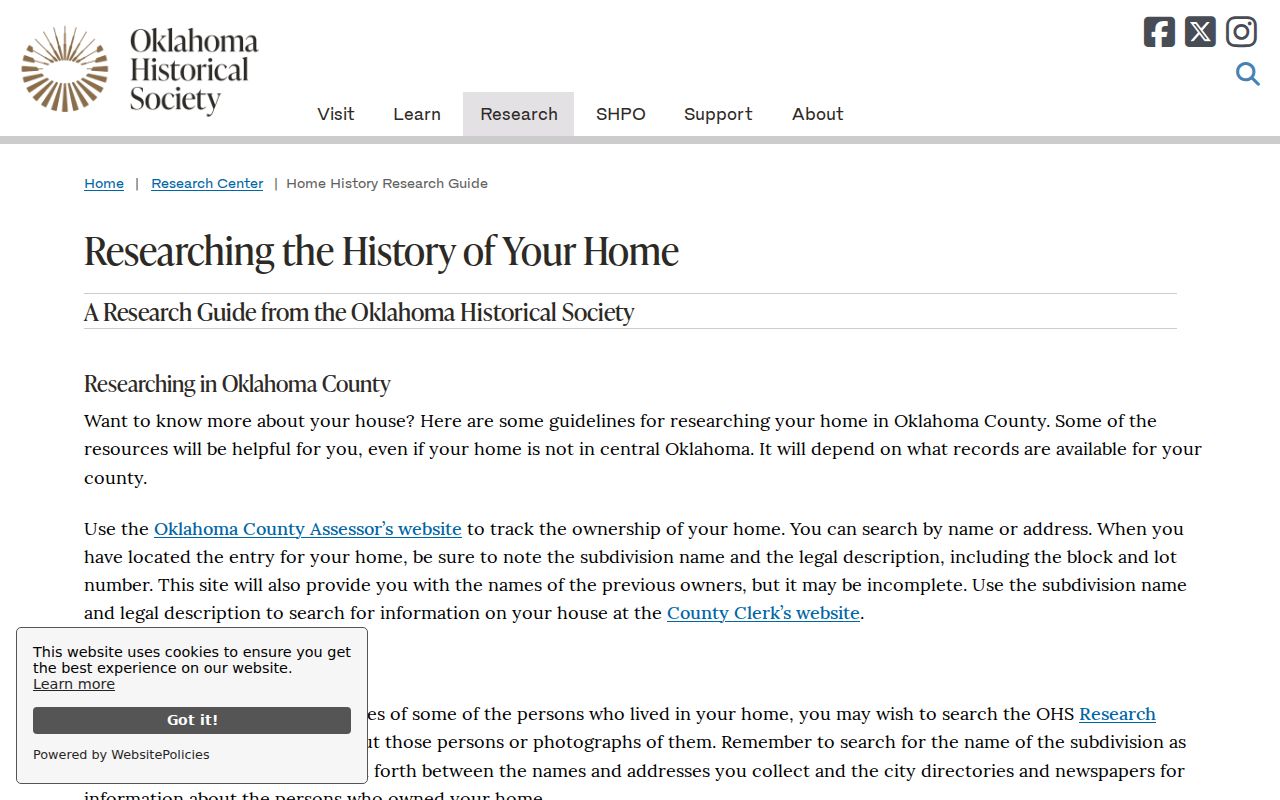
The guide supports using an address as a starting point, then preserving the legal description and subdivision vocabulary needed to verify the next Del City record.
Do not label a new postal format as an historical renumbering. A real change needs a dated sequence, such as an earlier directory form, a later directory form, and a deed, plat, ordinance, or map that explains the transition. If the legal description remains constant while the street label differs, the parcel chain may establish continuity.
Note: Preserve the exact search form, source URL, and retrieval date whenever the index produces no result or a partial result.
Del City Households Between Transfers
Deeds establish a transfer, not necessarily the people who occupied an address during the interval. Metro describes city directories as having an alphabetical resident and business section, a street index, and a classified section. Its collections reach back to 1902 for metropolitan directories, although the exact Del City annual run needs a librarian or Special Collections confirmation. Search the street-index page first, compare it with the alphabetical entry, and transcribe any ownership notation exactly as the volume defines it.
Metro's home-history material pairs Polk directories, census records, Sanborn maps, newspapers, and Gateway. The public census sequence in HeritageQuest reaches 1950. Pairing a directory year with the nearest census year can test household continuity, but a printed entry remains dated evidence. The collection details and access options are kept with the Del City city directory resources.
- Choose the two directory years that bracket a recorded transfer or a known household event.
- Record the name, printed address, page, publisher, and the matching street-index entry for each year.
- Compare the nearest census year, keeping its district and page reference with the directory notes.
- Check a deed, plat, or newspaper item before describing a past household as tied to the same Del City parcel.
Del City History Before Incorporation
Del City's founding geography is an important historical filter. The Oklahoma Historical Society places George I. Epperly's first 160-acre purchase at SE 29th and Sunny Lane in 1946, records the first house in January 1947, and places incorporation on October 9, 1948. A 1940s or early-1950s directory, newspaper, plat, or probate lead may instead use Boone Township, Oklahoma County, Oklahoma City, or nearby Midwest City vocabulary.
The same source records Carter Park's 1954 absorption, Midway Village's 1963 absorption, and a 1964 resolution of the Tinker-area boundary. Search the place name appropriate to the date, then use a deed, plat, or municipal record to decide whether it points to the modern Del City area. The date is a search filter, not proof that someone moved.
Metro Library's home-history article brings directories, census material, Sanborn maps, newspapers, and Gateway into one practical research sequence.
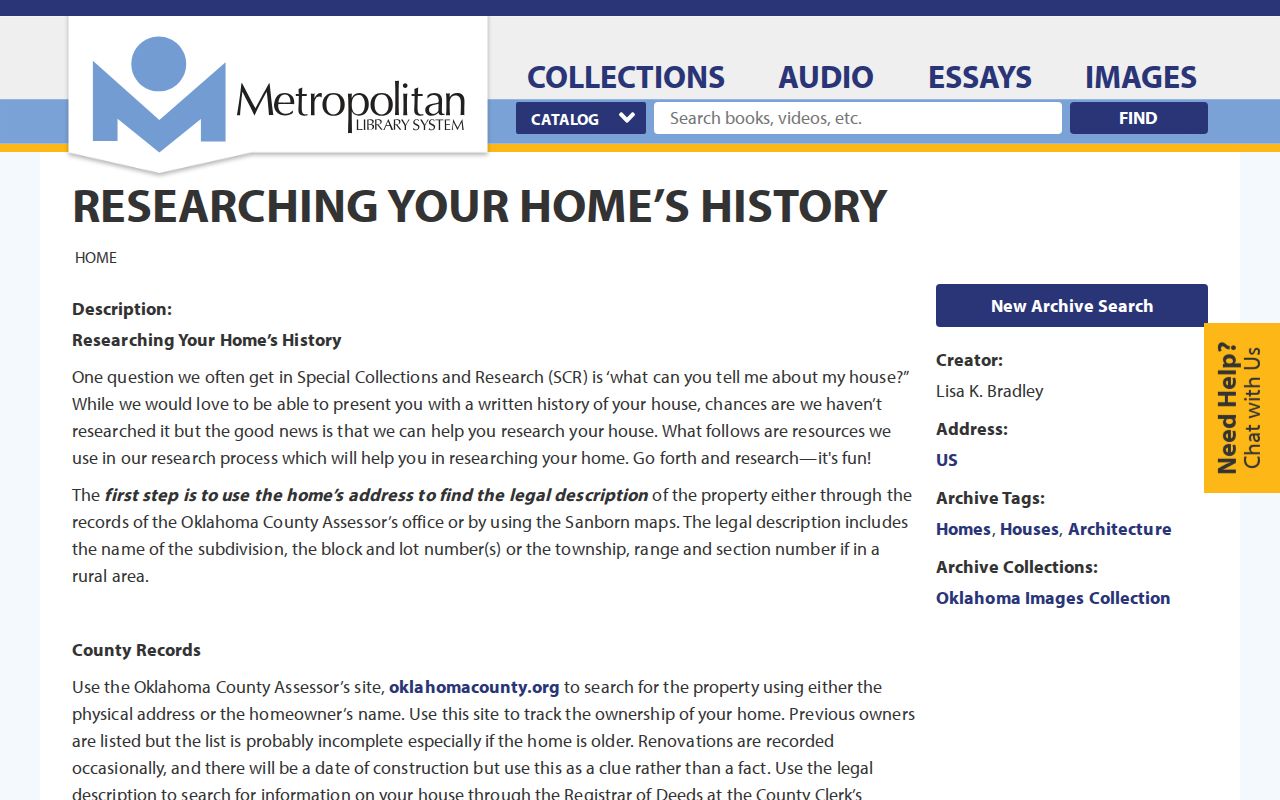
Its layered approach helps test whether a Del City address belonged to an earlier addition or metropolitan label before a current street search is treated as complete.
Del City Plats and Local News
Plats and newspapers offer two different kinds of context for a Del City address. A plat can supply the addition name, city label, date, and land description that become new County Clerk and Assessor search terms. The OHS plat-map index includes Del City among more than 3,400 entries. Its listed copy route is useful when an addition name is missing from a modern address result.
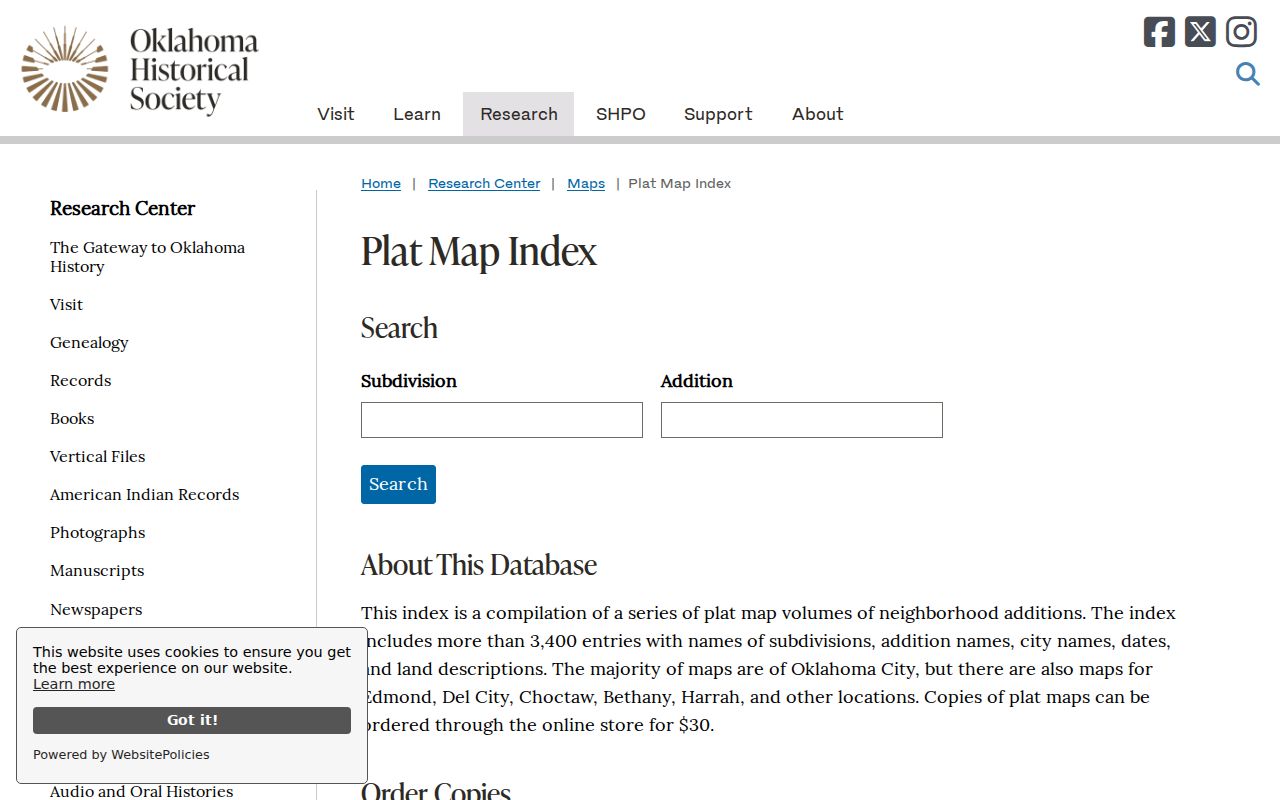
A Del City plat result can bridge a parcel to the addition and block terms that make an older instrument or directory search more precise.
Gateway's Del City News title spans 1953 through 1980, but the currently digitized run shows 1957 through 1960. Search the full number and a written-out number, the directional form, an intersection, and the addition name. A missing result after 1960 is a coverage issue to route to OHS or the Del City Library for a microfilm or physical-holding check, not proof that no article exists.
Del City Address Record Gaps
A negative result deserves the same care as a positive lead. For each Del City search, keep the source, URL, exact terms, date, filters, and whether the record was not located, not public, not digitized, subject to a coverage gap, or needs an in-person search. That record makes it clear which route has been checked and which custodian remains.
For a historical address, compare three source types when possible: a directory or yearbook entry, a deed, probate, court, or vital record, and a newspaper, plat, or municipal record. They should agree on the name and year while the deed, plat, or Assessor record anchors the geography. If only one source survives, describe it as a dated lead and retain the uncertainty.
Note: The reviewed portal fields, fees, and availability reflect material described as of August 30, 2026 and should be checked with the custodian before relying on them.
Del City Past Household Clues
OHS holdings provide useful endpoints for a Del City household trail. The Research Center lists Oklahoma County probate material from 1890 to 1928, Oklahoman obituaries from 1972 to 2014, selected Oklahoma City death notices from 1918 and 1920 through 1923, and funeral-home records and programs. Those indexes can identify a date, relationship, estate, or notice that points back to an address record. They are not substitutes for the underlying court or vital record.
Historical households are best described with the date and source attached. An address may identify a property owner, a directory may identify a household at a point in time, and an obituary or probate record may add a later family connection. Keeping those roles separate makes a Del City history more accurate than collapsing every name into a single household list.
Lawful use. Del City previous-resident research is for house history, family history, estate questions, and personal curiosity. Do not use a dated record to harass, monitor, or harm a living person.